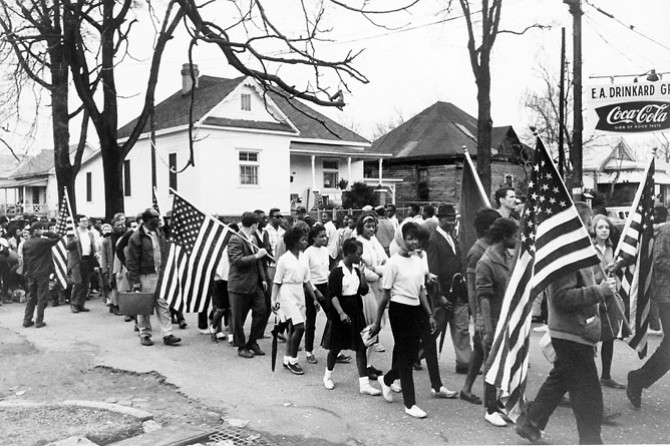
The Civil Rights Movement was at a peak from 1955-1965. Congress passed the Civil Rights Act of 1964 and the Voting Rights Act of 1965, guaranteeing basic civil rights for all Americans, regardless of race, after nearly a decade of nonviolent protests and marches, ranging from the 1955-1956 Montgomery bus boycott to the student-led sit-ins of the 1960s to the huge March on Washington in 1963.
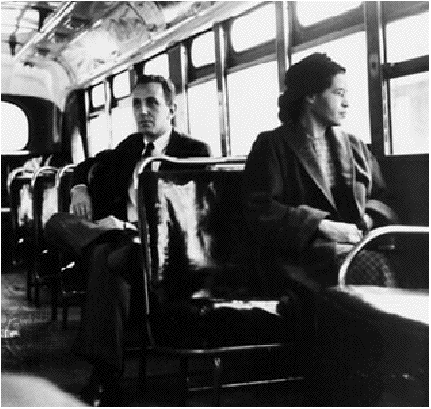
The Montgomery Bus Boycott: Officially started on December 1, 1955. That was the day when the blacks of Montgomery, Alabama, decided that they would boycott the city buses until they could sit anywhere they wanted, instead of being relegated to the back when a white boarded. It was not, however, the day that the movement to desegregate the buses started. Perhaps the movement started on the day in 1943 when a black seamstress named Rosa Parks paid her bus fare and then watched the bus drive off as she tried to re-enter through the rear door, as the driver had told her to do. Perhaps the movement started on the day in 1949 when a black professor Jo Ann Robinson absentmindedly sat at the front of a nearly empty bus, then ran off in tears when the bus driver screamed at her for doing so. Perhaps the movement started on the day in the early 1950s when a black pastor named Vernon Johns tried to get other blacks to leave a bus in protest after he was forced to give up his seat to a white man, only to have them tell him, "You ought to knowed better." The story of the Montgomery Bus Boycott is often told as a simple, happy tale of the "little people" triumphing over the seemingly insurmountable forces of evil. The truth is a little less romantic and a little more complex.
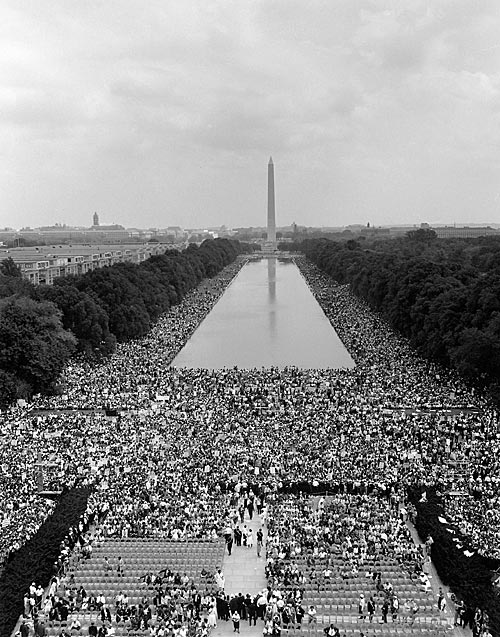
The March On Washington: After Birmingham, President Kennedy proposed a new civil rights bill. To show that the bill had widespread support, civil rights groups united to organize a March on Washington. Organizers hoped to draw a crowd of 100,000, but instead over 250,000 people from around the nation, arriving in more than thirty special trains and 2,000 chartered buses, descended on Washington, DC on August 28, 1963. There, they heard speeches and songs from numerous activists, artists, and civil rights leaders. Martin Luther King, Jr., delivered the closing address, his famous "I Have a Dream" speech.
The day was an overwhelming success. There was no violence and the event received extensive media coverage. Although it did not have an immediate impact on Congress -- Kennedy's civil rights bill was not passed for nearly a year -- it affected in some way just about everyone who participated or watched.
Selma, Alabama: In 1963, Selma, Alabama, was a small town of about 30,000 people. It was located in Dallas County, where only 1% of eligible blacks were registered to vote. Many blacks were apathetic about voting, which they saw as "white folks' business." As in Mississippi, it was supremely difficult for blacks to register to vote. The registrar's office was only open twice a month, and the registrars often came in late, took long lunch breaks, and went home early. Few blacks passed the required test for registration, even though they were sometimes more educated than the registrars. Once, an official giving a test to a black teacher stumbled over some words. "The teacher finally said, `Those words are "constitutionality" and "interrogatory,"'" remembered Amelia Boynton, a black Selma resident and activist. "The registrar turned red with anger. [The teacher] flunked the test and was refused her registration certificate."
