Rosa Parks

On December 1, 1955, in Montgomery, Alabama, Rosa Parks, an African-American seamstress, left work and boarded a bus for home. As the bus became crowded, the bus driver ordered Parks to give up her seat to a white passenger. Montgomery's buses were segregated, with the seats in the front reserved for "whites only." Blacks had to sit at the back of the bus. But if the bus was crowded and all the "whites only" seats were filled, black people were expected to give up their seats—a black person sitting while a white person stood would never be tolerated in the racist South. Rosa had had enough of such humiliation, and refused to give up her seat. "I felt I had a right to stay where I was," she said. "I wanted this particular driver to know that we were being treated unfairly as individuals and as a people." The bus driver had her arrested.
Martin Luther King, Jr.
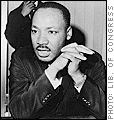
It wasn't just that Martin Luther King became the leader of the civil rights movement that made him so extraordinary—it was the way in which he led the movement. King advocated civil disobedience, the non-violent resistance against unjust laws: "Non-violence is a powerful and just weapon which cuts without wounding and ennobles the man who wields it." Civil rights activists organized demonstrations, marches, boycotts, strikes, and voter-registration drives, and refused to obey laws that they knew were wrong and unjust.
These peaceful forms of protest were often met with vicious threats, arrests, beatings, and worse. King emphasized how important it was that the civil rights movement did not sink to the level of the racists and hate mongers they fought against: "Let us not seek to satisfy our thirst for freedom by drinking from the cup of bitterness and hatred," he urged. "We must forever conduct our struggle on the high plane of dignity and discipline." King's philosophy of "tough-mindedness and tenderheartedness" was not only highly effective, but it gave the civil rights movement an inspiring moral authority and grace.
Little Rock Nine
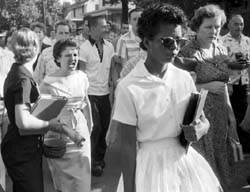
Little Rock High School, now Central High School National Historic Site, is a national emblem of the often violent struggle over school desegregation. Parting the Waters author Taylor Branch calls the Little Rock crisis "the most severe test of the Constitution since the Civil War."
Three years after the Supreme Court's Brown v. Board of Education decision, which officially ended public-school segregation, a federal court ordered Little Rock to comply. On September 4, 1957, Governor Orval Faubus defied the court, calling in the Arkansas National Guard to prevent nine African American students--"The Little Rock Nine"--from entering the building. Ten days later in a meeting with President Eisenhower, Faubus agreed to use the National Guard to protect the African American teenagers, but on returning to Little Rock, he dismissed the troops, leaving the African American students exposed to an angry white mob. Within hours, the jeering, brick-throwing mob had beaten several reporters and smashed many of the school's windows and doors. By noon, local police were forced to evacuate the nine students.
